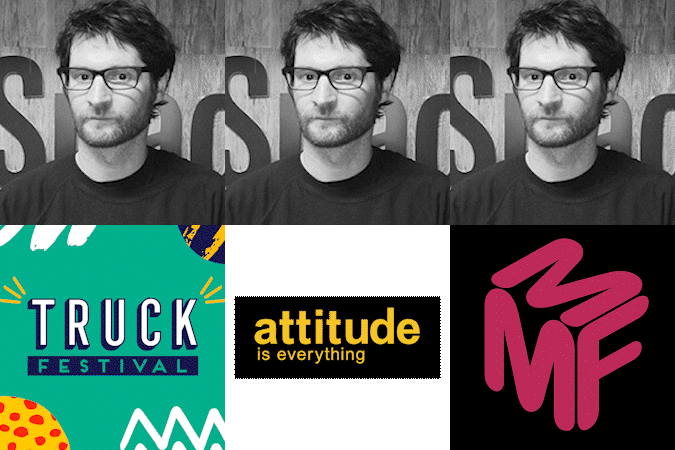
- Paul helps music managers build robust and sustainable businesses. At the MMF, the UK organisation representing more than 1,500 managers, he has led and developed the Accelerator Programme – a groundbreaking funding and training initiative that has benefitted more than 100 of the UK’s brightest and most entrepreneurial managers, including those representing artists such as PinkPantheress, FLO, Dry Cleaning, Nafe Smallz, Dream Wife, Porridge Radio, Shygirl and Moses Boyd.
- Formerly a Relationship Manager at Arts Council England, Paul broke into the music business as a teenager – helping to found Truck Festival in Oxford, before managing artists including Get Cape. Wear Cape. Fly, Drugstore and Bright Light Bright Light.
- Paul has also worked for the disability music and arts charity Attitude is Everything, and is currently on the board of trustees at Youth Music
Great to have you on Paul! So to begin, how did it all evolve from the beginning?
To be honest around the start we just did things very DIY. I didn’t really know how you got jobs in the music industry or what roles there were, me and my friends just sort of did things. I started promoting concerts as a 18 year old/17 year old and it just kind of grew from there. You educated yourself by talking to other people in the industry and learning from them, that’s how I did it.Pre-internet as well, which also is quite funny now.
There was also an event which happened in Oxford called BBC Sound City, which was a little bit like BBC Introducing now, but that was the takeover when I was about 17 in Oxford. And I think that probably did spark the fire that anything was possible, because I remember managers, and it’s like the conference basically, but it was free to attend. And I think that really let me have an awareness that you could make a living out of music, but when I started, I didn’t really know how I would make a living, and I didn’t really make a living for probably the first five years. We just made things happen.
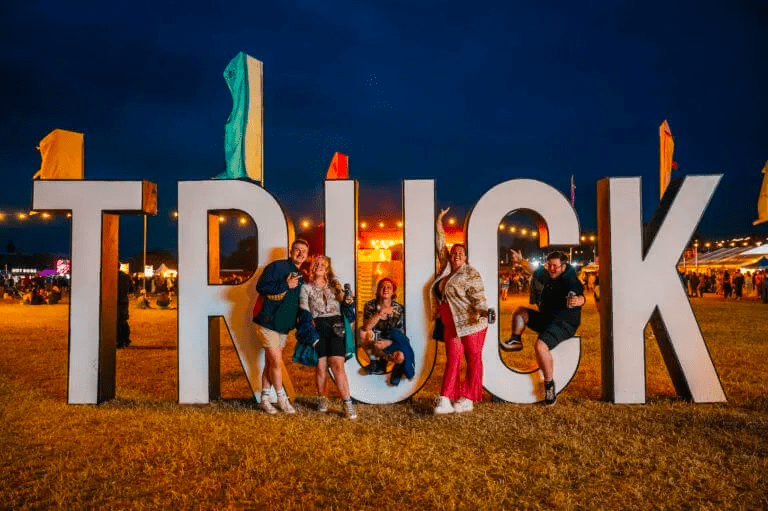
The people that I ended up working on truck with, I just met them through going to gigs. We just kind of met people and they were enthusiastic, they were in bands, they were perhaps putting on shows in their villages or in other genres, you know, and we all clubbed together and worked together. And I think that that community is what I really look for in music, is that it’s about working with people, it’s collaboration. And, you know, I really find that in the work that we do at the MMF now. I think that strong community is actually a real, real key part of making, making your business sustainable, making your career sustainable. You know, incomes will come up and down and up and down, but you’ve got to have your audience. You’ve got to know who your audience are and you’ve got to know who your allies are in the industry.
You studied social science at uni, how did that fit beside everything?
Yeah, I did study social sciences in London. That helped me do a lot of the work that I was building with Truck Fest and eventually management because it allowed me to be in London and also, you know, to use the hours outside university to really network and sort of get my head around what the industry was about.
The education for me was perhaps asking someone older than me what records I should go and buy. It was shadowing and meeting people that perhaps were running small businesses and you know getting to know people.
When you were doing that did you have a goal in mind? Did you want to work at a label?
No, no the answer is I never really had clear goals. And when I work with the Accelerators nowadays which is one of the programs I run, I do encourage them to have a two-year plan but I’m fully aware that plans always change.
I think I knew that I wanted to work with artists. And I wanted to probably not work for a big company, I didn’t really like the idea of corporate environment, and I didn’t actually find the corporate environment very inclusive to me.
They didn’t really reflect the type of characters that I met that worked for those companies. They didn’t really share the same values. I was quite aware of the lack of transparency or the way in which major corporations can sometimes treat artists.
So I think I’ve probably been more on the artist side whatever the project, whatever the discipline I’ve done. And I spent eight years working almost nine years as an art councillor to England, a funder.
And I think that’s where I sort of worked about how you can fund infrastructure and individuals to reach their goals. So I’m quite good at encouraging other people to have goals, but I don’t really think I ever really set about having set goals apart from I wanted to be around music.
So how did it sort of evolve into Attitude is Everything, the MMF, and now Youth Music?
Yeah, Attitude is Everything was actually a part time job that I did when I was running the festival and the record label. So I went in there as their business manager, so helping on fundraising, the budgeting and the marketing, and stuff like that.
It was actually a really tiny organisation – well it wasn’t even an organisation. It was a project at the time and I went in there to sort of just help grow it and we actually did like a five-year business plan when I was there and a five-year kind of marketing and communication plan and I then left because the freelance work I was doing with my artist management took over and then I became a board member as we established Attitude is Everything.
Getting my head into the inclusivity and disability politics was actually really fundamental and I think understanding the barriers, being physical or attitudinal, has really I think influenced the way I try and have an inclusive practice to the music industry no matter which role I’ve ended up in.
Did it involve meeting a lot of people and then to know what sort of barriers they might be facing?
Yeah, like you know we work very hands-on at music festivals with disabled audiences. I also wanted to know a lot of disabled activists and artists (not just musicians) and really understand campaigning, and the power of artists making quite political work that can challenge norms and attitudes. I had a great mentor and and guide in Suzanne there who runs Attitudes is Everything, I learned a lot and that was really important to me.
There’s an approach to disability which is called the Social model of Disability and basically rather than looking at the individual that has an impairment, it actually says that it’s society and the way that it includes that person that disables them.
It’s not the individual you know it’s not if someone’s got a health impairment or you know a condition of some sorts that disables them it’s actually the way in which society treats that person and builds those barriers either physically or attitudinally and that’s a fundamental sort of shift in in in the way in which people think about access and inclusion in general I think, but particularly around disabled people.
So yeah, that was brilliant, and even the artist that I worked with, Get Cape. Wear Cape. Fly he was very socially aware. We did a lot of work, we loved music, I based it on them, and we did a lot of campaigning, putting out, like even his first few singles, I had to really sort of fight to get them on recycled cardboard and all of that, like the packaging.
We did a lot of work with various different charities, from Oxfam to Action Aid. Yeah, it was campaigning, that was always part of what I see artists can have a role in doing. I think great artists like comment and move our society on.
And you mentioned having a mentor there. Is it something that people should look into a little bit more?
Yeah, I think that mentoring can become too formal and therefore then people sort of feel that it should be desirable. Whereas I think it’s more about mentoring by self. I think it’s about how people can experience meaningful relationships with people that they’re willing to learn from.
And it’s not necessarily about having to be part of a program. I think that everyone’s always mentoring if they’re willing to learn as they go through their life. So I think it’s about lifelong learning and intergenerational or intersectional learning.
I don’t think you want a mentor that’s just like you. For me, I think it’s the only real mentoring if you’re building meaningful relationships with someone you can learn from.
So yeah, everyone I think if you have that approach to your self development, then you’re going to be more ahead of the game. I think sometimes mentoring can be a concept where people feel like they’re waiting for Superman to sort of make things happen for them.
I found in general, if you’re up for asking questions, someone’s going to give you the answer. And you might not even like that answer, but go and ask another person. Yeah. You know, I think that if you’re up for asking questions, then you’re going to get mentored. Yeah.
What have you noticed about the pool of managers and artists over the years?
I’ve definitely seen more, there’s more diversity, more awareness around inclusion. There’s still a lot to be done and I also think that there’s a lot of people who might feel that they look different, but perhaps have still got a lot of similarities.
I think it’s more the hidden diversity characteristics that are less addressed nowadays. We’re doing an evolving and better job around representation, I think, but it’s some of the more complex hidden characteristics that people don’t really get acknowledged.
So it might be about if you’ve had the access to the education or you speak in a certain way, then you’re going to get further on. That kind of comes because it’s quite easy to do that. You can relate someone if they’re communicating in a similar style or knowledge that your industry is used to.
So I think that it’s an evolving, it’s more subtle, I think, the things that need to go now. I think if you know you might be starting in the industry later I think there’s a lot of ageism in the industry. There’s a lot of focus on internships for young people, but what if you are coming into the industry later in life? You’re sort of changing your career, there’s not as many access points there.
And I’m a great advocate for supporting young people. I think you mentioned earlier on the board of Youth Music, the charity and funder that supports young people in music, as music makers, to earn and learn in a fair motto.
And one of the first jobs I did when I was sort of 20 was working on a Youth Music project. But it’s across the board and how we also sustain knowledge, particularly of freelancers and particularly female and gender minority freelancers that perhaps get marginalized as they age or with experience in the industry.
Do you think there’s a certain part of the UK that should be nurtured in the same way London is?
I don’t think that’s very helpful because the populations are just so massively different and the connectivity globally. Where I think there is probably not enough acknowledgement is both in regional development, but also sort of genre development and specialist communities again.
I think the industry sort of waits for things to rise. So, you know, there’s been a really, really good growth, I think, for some UK acts that can do very well regionally, you know, that have sort of guitar bands that build those audiences for association with the football clubs, all the dominant culture in a place. But I think that if you’re a more marginalized or niche artist, then that perhaps doesn’t get enough opportunity. I think that at the MMF we’re really aware of this and we’re working in partnerships in very different ways with different geographies.
So we started a big project that we’re doing in Wales at the moment and what we do in Wales is very different to what we’re doing in Manchester. We got a particular focus on Manchester in 2023. In the new year I want to start doing some work in the northeast and it’s a very different approach that we’re hearing to what they’re looking for on the Managing Development Fund. So I think each geography is quite different anyway, and the needs.
I think it’s about working authentically with different partners. What I like about what we do at the MMF, like our Accelerator Program, we have consistently been 50% outside London, and I’m really happy about that.
Because that’s the average over the five years and I’m really pleased that we’ve grown that program to be national or to feel that it’s much more nationally represented. I’ve really enjoyed the music that’s come from these different places.
I don’t think that the answer is to say every record label should have a company based in every city because every city is different and their needs might be different, the artists might be different, they might not want record labels, they might want to be more independent. Places have cultural and musical identities that are very different. So yeah, there’s not one answer to it. I think what’s really good again, sort of talking about funding is like youth music funds at least 80% of its work outside London.
I think Arts Council are really, really knowledgeable about different geographical differences and having a commitment to them. So I think that there’s approaches there.
Can you tell me anything about what’s exciting and growing in the music industry at the moment?
Oh, wow. I mean, I’ve got a very eclectic music taste, and I put that down to loving the John Peel show when I grew up, that was a BBC presenter.
I mean, at the moment, there’s just so much. Like, you know, the Afrobeats scene, that I know very little of, there’s the occasional track that I hear that, I’m like “Yeah, that’s amazing”.

UK rap is absolutely phenomenal at the moment. I went to go and see Central Cee at Reading. I’ve been going to Reading since I was 16, I had other stuff on that weekend, but wanted to see that live. And it was even before he went on to hear the DJ say “New UK Rap, Let’s celebrate it” and the audience going wild for it. I was just like this is brilliant because I’ve seen it be really tough like “Oh, that will never get anywhere. That doesn’t exist” you know, and to see that moment was absolutely just so significant.
I also think it’s really great how the way in which British composers and sort of that more experimental work is getting a lot more respect.
I think that there’s sort of of a global market that those artists can now reach, they can build sustainable careers. There’s also many more opportunities to do sort of smaller commissions to the film, soundtrack, TV, sync, etc. So it’s like a new way of reaching an audience that doesn’t rely on touring or streaming, which generally has a young audience, so I think that’s great.
And I think record shops are in a real health. You know, I love the fact that they’re a really vibrant scene and celebration of record shops. Some artists really, really work as you know, as albums on vinyl. So I think that it’s great that there’s so many different routes for artists to build more sustainable businesses than there was before.
It was all about what was in the top 20 chart, whereas now there’s different career routes for artists to consider, for managers to build various rosters of clients in different ways.
I suppose a lot of people say that it’s all about TikTok nowadays, but there should be more avenues for people nowadays more than ever?
So yeah, that’s it. There’s more avenues. TikTok and marketing has always played a role. And yes, TikTok can make a hit or it can help you reach audiences in a different way, but it’s about sustaining the fan base.
And that’s what I think you’ve now got is more routes to sustain the artist you are. You can’t make living just to be a TikTok hit because I don’t think anyone’s really done that. You don’t have to be a touring artist now to to make money you could be a streaming artist, you can be a really good touring artist that doesn’t stream but there’s different groups. I think that’s the much more interesting side to look at anyway.
So yeah, that’s it. There’s more avenues. TikTok and marketing has always played a role. And yes, TikTok can make a hit or it can help you reach audiences in a different way, but it’s about sustaining the fan base.
You know people laugh, when I am a bit old now like people are like “Oh it’s really hard, it’s really hard”, I’m like “it’s actually a lot easier”. When I had started a label we pressed like 507 inch singles. We had to try and get those 507 inch singles to real fans that would then convert to people that would buy albums or distribute them in, you know 300 record shops.
You had to distribute them and no one ever bought them because you know, you couldn’t really market them. We were losing money. Now, you can put a track up and there’s different ways of reaching people. It’s so much easier. There’s so much more Equity removal at entry point, but because of that there’s a lot of competition of course,
What would you say is like the best part about working your job and then what’s the worst?
Well nowadays I love working directly with people and cascading information. So trying to get knowledge be that through the trainers and partners that we work for or be that through one another because there’s a great peer community that we’ve got at the MMF where you know someone will come and say oh, “I’ve got a question about this”, and we can be like “Oh I know a person that is really good at that you should meet”. So I think that’s the thing I love most about the job
And for the worst part.. Nowadays, and particularly post lockdown, it’s our ambition and our knowledge is that we know that we’ve got so many members all over the country and we’ve really grown, we had about 500 members to 1,500 now. And in lockdown, everyone was sort of at home, they were all in one place. But when I was talking earlier about sort of getting knowledge out to people, now everyone’s on different timelines, everyone’s busy, and there’s some information, managers are expected to know. It’s like how do we support them best? And alongside that, because we really want to work with people nationally and we found out we know we can do that now.
You know, you can go to a place once, but it doesn’t work for everyone that’s in the area because they’re out of town, or they’re in London and all that. I know they’ve got kids or they’ve got other jobs, which a lot of managers do, you know? And so it’s like, we were going to do it at this time, but you can’t make that, it’s sort of frustration to deliver on our ambition.
And what motivates you?
Usually my phone rings. Yeah, like the need is, it feels like it’s there. And so I wake up and I work with purpose. And I think that’s always been really important is that jobs are functional. Whereas, no, working jobs are functional, but doing something you enjoy should feel purposeful.
I think that in music you can find the most purposeful jobs ever because it usually is something that resonates in your heart. But you know, the memories of it go right back to your childhood.
For me anyway, I had favourite moments when I was a child. you know, only four years old or something, and hopefully will stay with me for life. And I think that’s very rare. I don’t know if there’s many industries where people have that relationship to the output of their work.
What are your upcoming artist recommendations?
Currently I’m loving new music from:
Nondi_, Gossip, Infinity Song, Black Sherif, cumgirl8, Lonnie Holley, Welly and Iona Zajac
 ARTIST AVENUES
Leave a comment